
Building Trust Signals When You Have No Backlinks Yet
If you’re running SEO for a small business, you’ve probably heard that backlinks are the currency of trust online. That’s true as far as it goes, but it leaves out an uncomfortable question: what are you supposed to do in the meantime, while your link profile is thin or nonexistent?
The answer isn’t to fake authority you don’t have yet. It’s to make sure every other trust signal available to you, the ones search engines and customers can evaluate without a single external link, is doing its job. Most small business sites leave several of these on the table.
Why Backlinks Aren’t the Only Signal That Matters
Backlinks are useful because they’re hard to fake at scale. A link from another site is, in theory, a vote of confidence you didn’t control. But search engines have never relied on links alone, and neither do the people actually deciding whether to call you or fill out your form.
Ask yourself: when you land on an unfamiliar business’s website, do you check who links to them? Almost certainly not. You check whether the site looks current, whether the business has a real address and phone number, whether other people have reviewed them, and whether the content sounds like it was written by someone who actually does the work. Those are trust signals too, and you can build most of them starting today.
On-Site Signals That Establish Who You Are
Make Authorship and Ownership Legible
Does your site clearly state who runs the business, what their background is, and where they’re located? A generic “About Us” page written in the passive voice (“we strive to provide…”) signals the opposite of trust. Specifics do the work: names, credentials, years in operation, licensing or certification numbers where relevant, and a real physical address if you have one.
This matters more for topics where expertise is scrutinized, such as health, finance, legal, and home safety, but it helps in any category. The question to ask of every page: could a stranger tell who is accountable for this content?
If more than one person does the work customers are paying for, consider naming them too. A staff bio with a real name, a role, and a plausible amount of relevant experience is a small addition that does real work. It turns “this business” into “these specific people,” which is harder for a visitor to dismiss and harder for a competitor to copy convincingly.
Check Whether Your Content Reads as Specific or Generic
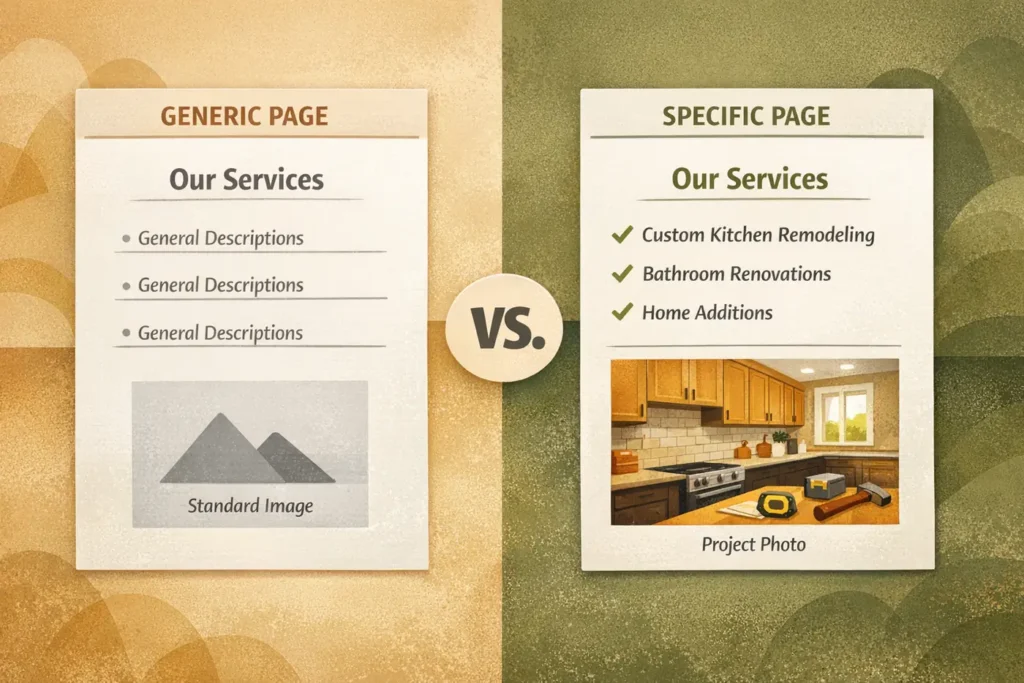
Thin, templated service pages are among the more common ways small business sites undercut their own credibility. If your “Plumbing Services in [City]” page could be copy-pasted for a competitor two towns over by swapping the city name, that’s a signal to both readers and search engines that there’s nothing distinctive backing the claim of expertise.
Look at your core service and product pages and ask: does this page contain a detail only someone who actually does this work would know? Pricing ranges, process steps, common failure points, materials used, timelines: specifics are what separate a credible page from a placeholder.
Keep Content Current
A page that’s obviously stale, with outdated pricing, a copyright year that hasn’t moved, or references to a promotion that ended two years ago, tells a visitor the business either isn’t paying attention or isn’t actually operating anymore. This is a low-effort trust signal to fix: a periodic pass through your core pages to correct anything that’s gone out of date is usually enough. You don’t need to publish new content constantly; you need to make sure the content you have isn’t quietly lying about the present.
Audit Basic Technical Hygiene
Trust signals get undermined by small technical failures that most business owners never check directly:
- Does the site load without errors on mobile?
- Is there a working HTTPS certificate with no mixed-content warnings?
- Do your contact and policy pages (privacy, returns, terms) actually exist and load?
- Are your NAP details (name, address, phone) consistent across every page they appear on?
- Does your contact form actually deliver a message when you test it yourself?
- Are there any old landing pages still live that reference a service, address, or offer you no longer provide?
None of these are glamorous, but inconsistency in basic details is one of the more common reasons a business’s credibility gets questioned before a visitor even reads the content. Testing your own contact form and checking for stale landing pages costs almost nothing and catches failures that would otherwise sit there silently losing you inquiries.
Off-Site Signals That Don’t Require a Single Backlink
Business Listings and Citations
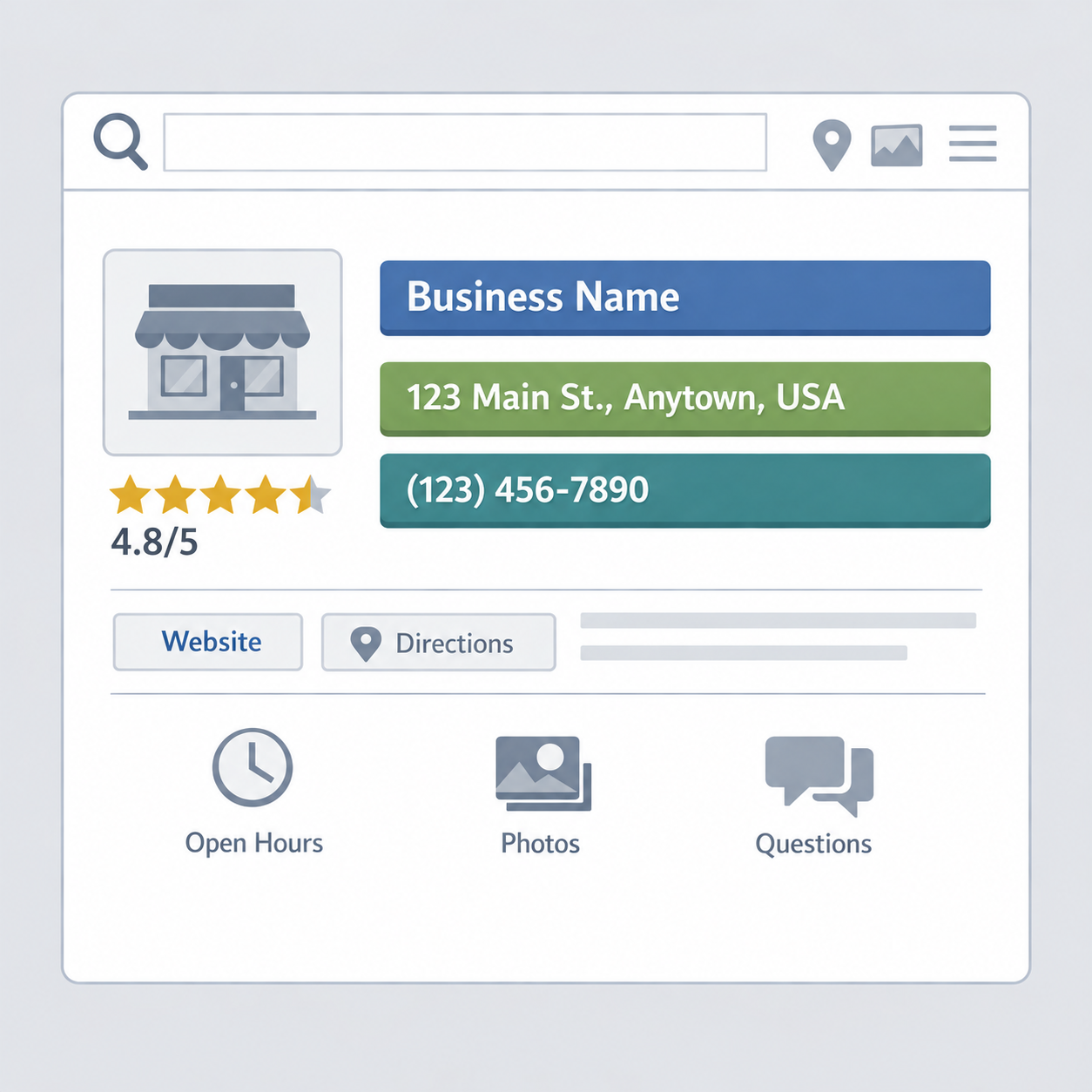
Consistent listings on Google Business Profile and relevant industry or local directories function as a form of third-party confirmation that your business is real, current, and located where you say it is. Accuracy and consistency across those listings is generally treated as at least as important as sheer volume. A handful of accurate, matching listings is more useful than dozens with conflicting addresses or phone numbers, though the exact relative weighting isn’t something search engines publish. Start by pulling up your business on Google, Bing, and the two or three directories most relevant to your industry, and check that the name, address, phone number, hours, and category match on every one.
Reviews, Handled Honestly
Reviews are one of the most visible trust signals available to a small business with no link profile. The instinct to chase volume is understandable, but the more useful question is whether your review profile looks authentic: a mix of ratings, responses from the business, and reviews that mention specifics rather than generic praise. Buying reviews or incentivizing only positive ones can create patterns, such as reviews clustered in a short window, repetitive phrasing, or an implausible ratio of five-star ratings, that platforms and attentive customers are increasingly able to recognize as inauthentic.
If you have real reviews scattered across Google, industry-specific platforms, or social channels, make sure they’re easy to find from your site rather than buried.
Structured Data as a Clarity Signal
Schema markup, such as Organization, LocalBusiness, or Article/Service schema depending on the page, doesn’t create trust on its own, but it does make it easier for search engines to correctly interpret who you are, what you offer, and how to contact you. Think of it as removing ambiguity rather than adding persuasion. Ambiguity is often what causes a legitimate business to get treated cautiously.
Behavioral Signals You Can’t Directly Control, But Can Influence
Google does acknowledge one aggregate form of click-data use: in its How Search Works: Automatically generating and ranking results documentation, it says it uses aggregated and anonymized interaction data to assess whether search results are relevant to queries and turns that data into signals that help its machine-learned systems estimate relevance. That statement does not establish that any one site’s Google Analytics metrics, including bounce rate, dwell time, conversions, or return-to-results behavior, are direct ranking levers. Treat those metrics as contextual diagnostics for improving the visitor experience, not numbers to manipulate for rankings.
What’s less disputed is that these behaviors say something real about whether your site is doing its job for the person who arrived on it. A high bounce rate might mean weak content, or it might mean the page fully answered a simple question and the visitor left satisfied. The number alone doesn’t tell you which. Correlation between engagement metrics and rankings, where it’s observed at all, is not evidence that one caused the other.
What you can do is remove the obvious reasons a visitor would leave frustrated: pages that don’t match what was promised in the search result, slow load times, missing information they came to find, or a layout that hides the one thing they need (a phone number, an address, a price). Fixing these is worth doing because it serves the visitor in front of you, independent of any effect on rankings.
A Simple Audit to Run This Week
Rather than trying to fix everything at once, work through these questions for your own site:
- Can a stranger tell who owns this business and where it operates, within 10 seconds of landing on the homepage?
- Does at least one core page contain a detail that only someone with real expertise would include?
- Are your business name, address, and phone number identical across your site, Google Business Profile, and any directories you’re listed in?
- Do you have real reviews, and are they visible rather than buried?
- Does your site have basic schema markup for your business type?
- Are there any broken pages, expired certificates, or dead contact forms that would make a first-time visitor doubt you’re active?
If you can’t answer “yes” to most of these, that’s a more productive starting point than a link-building campaign, because a link pointing to a page that fails this audit isn’t going to convert the trust it sends.
Trust Signals Compound, Backlinks Included
None of this replaces the eventual value of earned links. But a site with clean, specific, consistent trust signals may be better positioned to earn references from other sites and journalists over time, though that relationship is a reasonable practitioner inference rather than something search engines or journalists have confirmed. In practice, this work isn’t a substitute for link building so much as a foundation that can make it easier to pursue. Getting the fundamentals right first tends to make the rest of your SEO effort more effective, not less necessary.
If you’ve already got traffic but it isn’t converting into leads, that’s a related but distinct problem worth diagnosing separately.
Run the six-question trust audit above on your own site this week. If you’re not sure how to prioritize what you find, we can walk through it with you.